DuckSale
Sports e-commerce
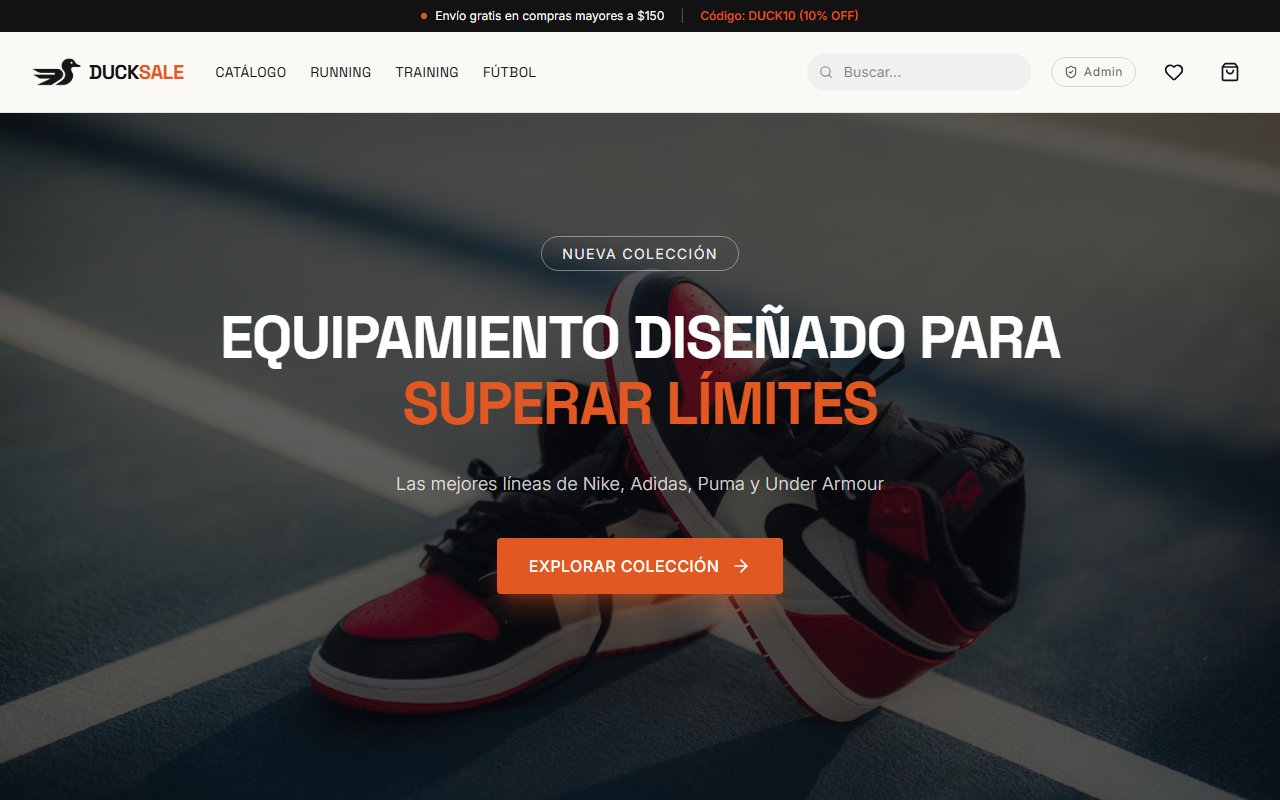
"A fully functional end-to-end sports e-commerce demo, built to show a potential client the quality of what we do without committing them from the start."
The starting point of the challenge
Digging beneath the surface: What did I investigate?
I analyzed purchase flows in sports e-commerce sites like Nike, Adidas, and local Argentine stores. Most demos I'd seen stopped at the product catalog and didn't go as far as simulating the full cycle (cart, checkout, confirmation, administration). I also noticed that clients tend to underestimate the complexity of an e-commerce until they see it working. Sports stores have particular needs like size and color filters, product variants and category promotions, and an audience that expects a fast and highly visual shopping experience.
"An e-commerce demo doesn't convince if it only shows nice products. It convinces when the client can walk through the full flow as if it were already their store. Including a functional admin panel was key, because the client doesn't just see what their users would experience, but also how they would manage their business day to day. The demo didn't need to be a catalog. It needed to be a simulation."
Understanding this pillar completely transformed the tactical direction of the project, allowing unnecessary noise to be filtered out and focusing on strict value.
Tradeoff Analysis: options on the table
Building custom software requires honestly evaluating scenarios. No architecture is perfect — every decision has a price:
Static landing page with product catalog
Faster to build but didn't show the real purchase flow. The client wasn't going to grasp the complexity or the quality of the final work.
Shopify or Tiendanube trial
Quick to set up but with a generic identity. It didn't demonstrate our custom development capability or allow personalizing the admin experience.
Full-stack SPA with real backend
Too time-expensive for a demo. It implied servers, databases, and deployments the client hadn't approved yet.
SPA with complete client-side simulation
Real shopping experience without infrastructure cost. It allowed showing catalog, cart, checkout, coupons, and admin panel, all working without a backend.
The Decision: The path chosen
WHAT ACTUALLY WORKED
The catalog with visual filters (sizes, colors, prices) and product detail pages with image galleries made a very strong impression. The discount coupons with pre-loaded chips made the promotional mechanics tangible. The admin panel surprised them: they didn't expect that level of control in a demo. The full flow, from choosing a product to order confirmation, transformed an abstract idea into something the client could touch and evaluate.
LIMITATIONS & TRADE-OFFS
Without a real backend, stock and orders aren't persistent between sessions or devices. Routing without React Router works correctly but sacrifices deep URLs and history navigability. Products are mock data; there's no real payment integration or shipping calculations with logistics APIs. The demo serves its purpose of showcasing quality, but if the client approves the project, the entire backend and real integrations must be built from scratch.
FROM GONZALO'S PERSONAL LOGBOOK: WHAT WOULD I DO DIFFERENTLY TODAY?
"I would integrate MercadoPago in sandbox mode to simulate real payments and make the demo even more tangible. I would migrate the router to React Router for canonical product URLs. And I would replace the mock data with a fake API so the transition to a backend is more direct if the client approves the project."
Retrospective note after launch