UXnicorp Academy
Building a modern web development course with Astro
"A performance-oriented educational platform that demonstrates, through its own architecture, the principles of speed, simplicity, and Zero-JS that it teaches."
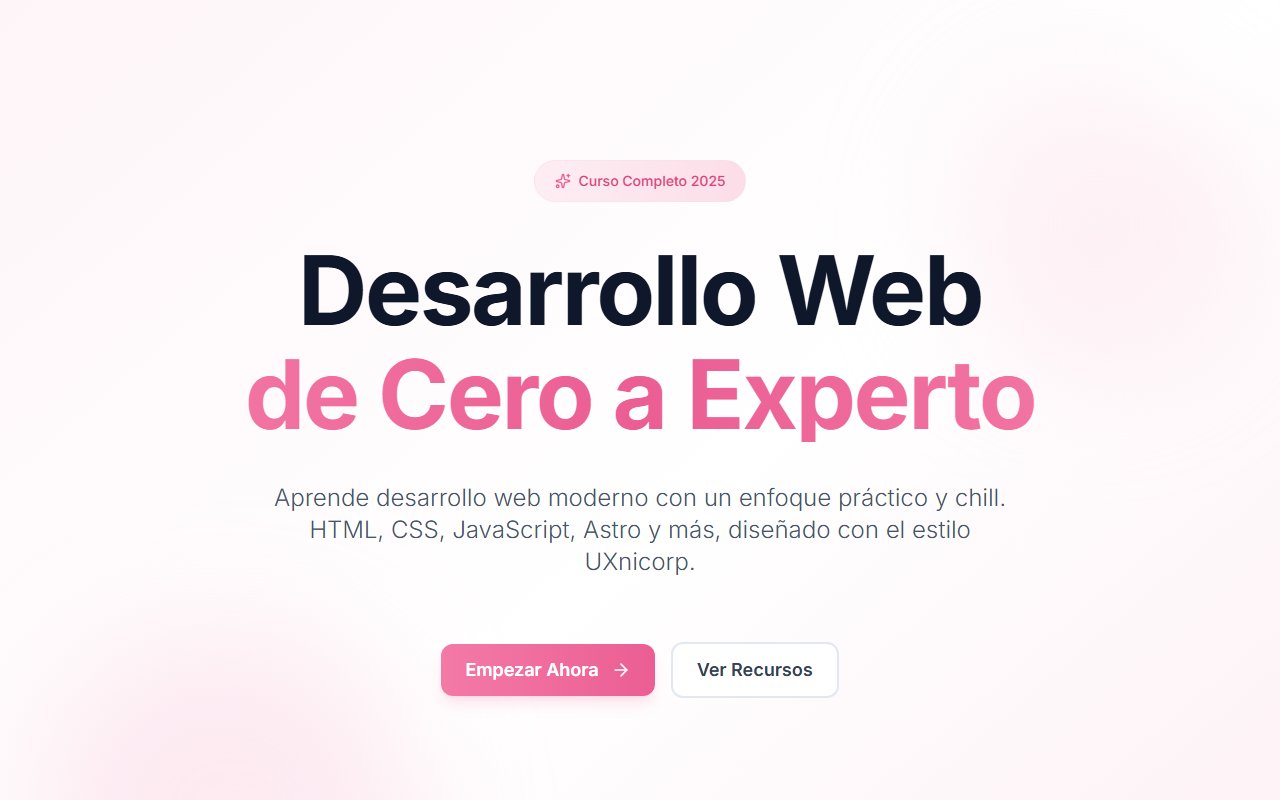
The starting point of the challenge
Digging beneath the surface: What did I investigate?
I analyzed platforms like freeCodeCamp, Udemy, Coursera, MDN, and YouTube tutorials. I observed four main problems:
- Too much passive video, which reduces retention and makes quick reference to concepts difficult.
- Ignored performance: educational platforms that used heavy SPAs while, paradoxically, teaching good frontend practices.
- Static or non-editable examples, drastically separating theory from practice.
- Early abstraction: courses that taught React before explaining HTML, the DOM, or how a browser actually works.
I understood that the course had to feel fast, clear, progressive, and interactive. And technically, the product had to be a reflection of what it taught: if you teach performance, the website has to load instantly.
"I defined key principles: Zero-JS where it's not needed (without loading heavy SPAs for static text), progressive interactivity (React only where it adds value: playgrounds, demos, theme toggle), content-first, and non-linear learning without unnecessary backend. The project made something evident that I had already been thinking about: architecture also communicates criteria. You can't teach good performance practices on a slow website."
Understanding this pillar completely transformed the tactical direction of the project, allowing unnecessary noise to be filtered out and focusing on strict value.
Tradeoff Analysis: options on the table
Building custom software requires honestly evaluating scenarios. No architecture is perfect — every decision has a price:
Next.js (App Router)
Advantage: excellent ecosystem and mature SSR. Disadvantage: too much overhead and unnecessary JavaScript for a static content site.
Gatsby
Advantage: content-oriented. Disadvantage: less modern DX and extremely slow build times.
Astro (Islands Architecture)
Advantage: renders static HTML, eliminates unnecessary JS, excellent performance, and perfect for educational content. Disadvantage: newer ecosystem and certain limitations with complex interactivity.
The Decision: The path chosen
WHAT ACTUALLY WORKED
Astro + Islands was the right call. The site is blazing fast, the interactive demos add value without making it heavy, and having no auth or backend doesn't just simplify everything — it leaves it open for anyone who wants to learn.
LIMITATIONS & TRADE-OFFS
Without a backend, progress tracking across devices is lost.
FROM GONZALO'S PERSONAL LOGBOOK: WHAT WOULD I DO DIFFERENTLY TODAY?
"I'd like to add more interactive demos in other modules, not just in CSS."
Retrospective note after launch